



The most expensive hot water is the water you’ve already heated—but failed to protect. In the heating industry, we often obsess over the raw power of the heat source: the boiler’s kW or the heat pump’s COP. But there is a silent thief in most commercial and high-end residential systems: uncontrolled recirculation. At 7:00 AM across India, most systems aren't just delivering hot water; they are destroying their own efficiency.
The 7:00 AM Stress Test: A Field Study
We recently monitored a residential site at Forest Trails, Bhugaon (Pune) to evaluate a critical but overlooked metric: recirculation effectiveness. What made this study unique was the perspective: using our IoT interface, we performed the evaluation via remote monitoring from a garden 20km away from the site. We didn't need to be in the plant room to see the physics failing.
The customer expectation was simple: immediate, consistent hot water. The reality was a high-stakes physics problem. At 7:00 AM, the system entered its first cycle. Within four minutes, the entire volume of water that had cooled in the pipes overnight was pushed back into the storage tank.
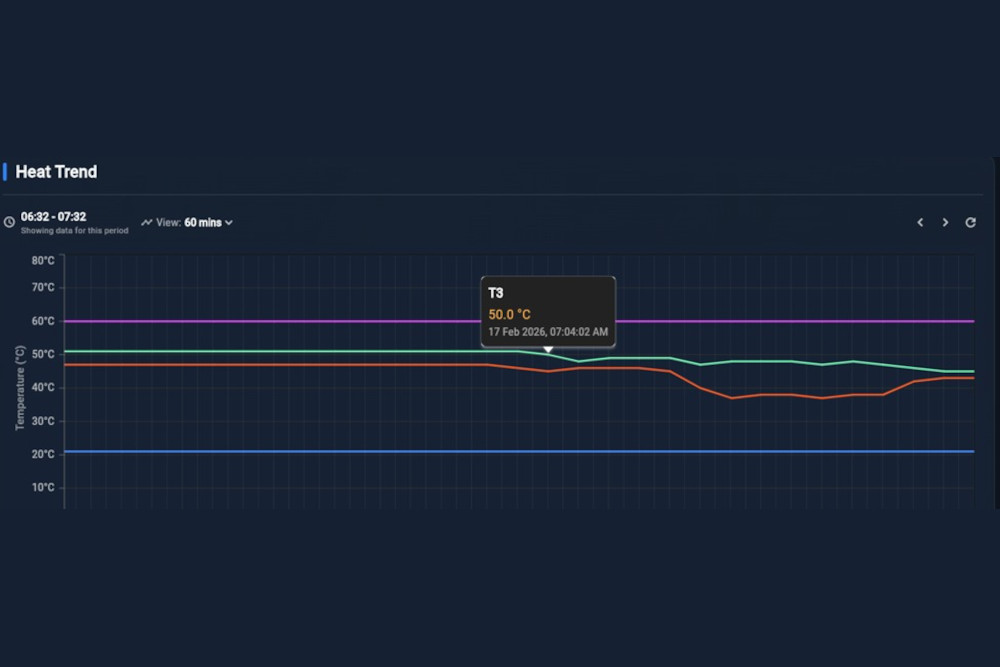
This "cold slug" acts like a piston. If managed poorly, it shatters the thermocline—the delicate boundary between hot and cold water—turning your stratified storage tank into a giant, lukewarm blender
The Horizontal Tank Dilemma
At the Pune site, we were dealing with horizontal storage tanks. Unlike vertical tanks, these have a much larger interface area between hot and cold layers. This geometry makes the thermocline inherently more fragile and prone to mixing. Data from the Forest Trails Study:
- 7:00 AM Tank Top Temp: 51°C
- 7:04 AM (End of First Cycle): 50°C
- 7:10 AM Stabilized at: 49°C
A total drop of just 2°C. This wasn't accidental; it was the result of precision hydraulic control. By maintaining a low Reynolds number (non-turbulent, laminar flow) at the inlet, the system "self-healed" its stratification within two minutes.
Where Traditional Systems Fail
Most consultants and OEMs "over-design" for safety, but that safety comes at a hidden cost. Field data, when captured, reveals three recurring patterns of failure:
1. Oversized Pumps: Designers often pick a larger pump to "ensure" flow. In reality, high velocity creates turbulence that shatters the thermocline, forcing the heater to work twice as hard to restore temperature.
2. Sensor Inertia: Temperature sensors live in metallic thermowells. This creates a "lag"—a low-pass filter effect. If your control logic doesn't account for this inertia, the system overcorrects, triggering unnecessary and expensive heating cycles.
3. The "Blender" Effect: Without intelligent inlet management, the energy you spent all night storing is degraded in minutes during the first morning draw.
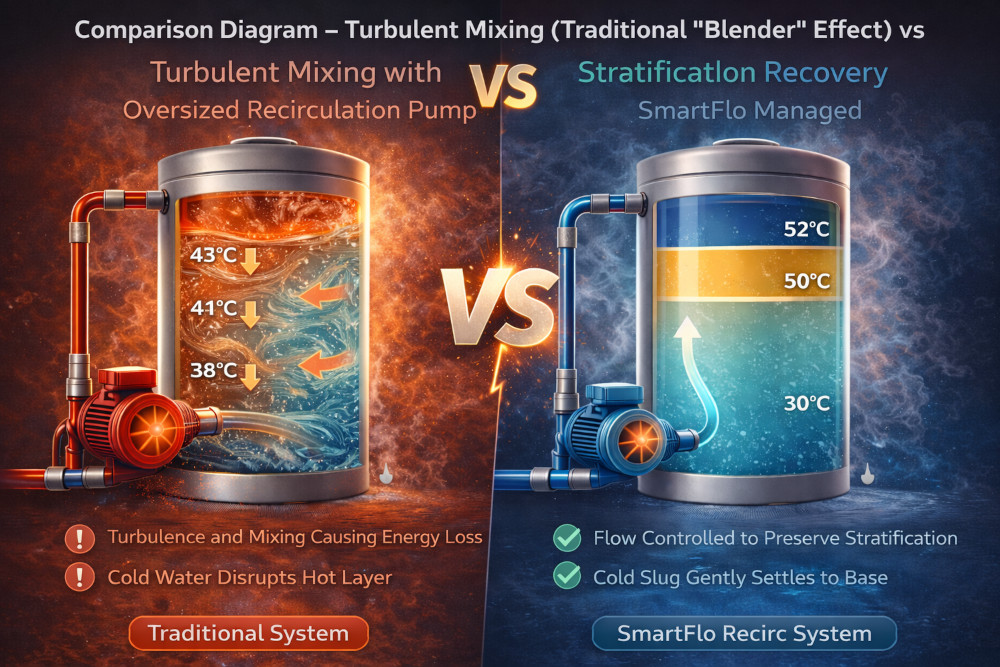
Introducing FloQore'patent pending': The Smart Caretaker of the Thermocline
This is why we developed FloQore. It is an IoT-based physical product designed to move recirculation from a background function to a precision-engineered process. FloQore doesn't just "move water"; it manages the invisible physics of the tank. By optimizing inlet conditions and using intelligent feedback loops that account for sensor inertia, FloQore ensures your system protects its most valuable asset: Thermal Stratification.
A Win-Win for the Value Chain:
- For Consultants & OEMs: Reduced call-backs, validated performance data (accessible from anywhere), and a system that meets modern sustainability benchmarks.
- For Decision Makers: Lower kWh consumption, reduced carbon footprint, fewer downtimes, and extended equipment life by preventing "short-cycling."
The Bottom Line
Efficient hot water isn't about raw heating power. It’s about controlled movement. Every unnecessary degree lost to turbulence is a waste of capital and carbon.
The question for your next implementation is simple: Is your system engineered to protect its heat—or is it quietly wasting energy through unseen turbulence?
Ready to see the field data behind your own system? Whether you are designing a new installation or optimizing an existing one, let’s ensure your recirculation isn't working against you. With FloQore, you aren't just running a system; you are watching every story your data wants to tell you.
Leave a Reply